What is an Avaydia?
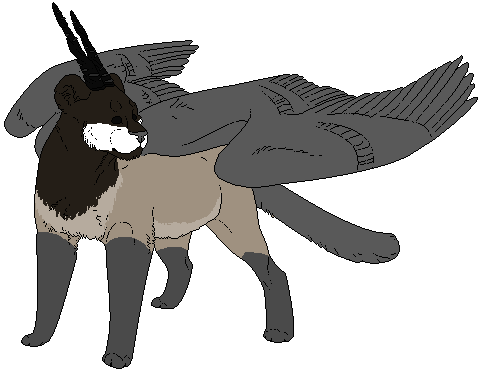
Appearance
Avaydians as a species have a fairly large build. Their bodies, while showcasing the same basic anatomy similarities of Puma concolor and Panthera pardus, are much larger. A typical Avaydian’s body is 180” from nose to tail, or approximately 15 feet in length - wings not included. Females are a bit smaller, though this is one of the few physical differences. The each wing can easily be upwards of 25 feet in length, wingspans over 60 feet are not uncommon. Inside of each bone, instead of the spongy dense marrow known to mammals, the Avaydians have a nearly hollow bone structure, supplemented with small filaments inside for support. Only their horns are completely solid.
The horns, a pair of fluted spiraled horns, are a trait of each Avaydian. They are most commonly used for attack, whether during a hunt or a show of dominance. The horns are never shed, and they continue to grow throughout the individual’s life. Another notable characteristic of the horns is that they share the same pigmentation as the eyes, and the eyes and horns will always be the same pigment.
The eyes are solid pigmentation, there is no ‘white’ of the eye, nor is there a pupil. Similarly to birds, the Avaydians have three eyelids. One upper and one lower lid, as well as a third semi-translucent lid which flits horizontally across the surface of the eye. This lid allows protection from foreign substances, as well as a way to protect the eyes from bright sunlight. The lack of a pupil means that there is no dilation to control light intake.
The Avaydian’s pelt can range from a thin, sleek coat to a thicker coarse coat. Some have been known to flaunt an even longer coat. The paws are padded, and function with retractable claws. An Avaydian’s tail is helpful in keeping balance while climbing or flying.
An Avaydian is subject to deformities and unique traits like any animal. Most common are fur lengths and the lengths of tails. These abnormalities have little to no effect on the overall well-being of the animal, but there are several more harmful mutations that have been known to occur occasionally. The most common of these include shortened, or ‘clipped’ wings; wings that have either never fully grown or have shortened feathers, but even this is extremely rare.
Diet
An Avaydian’s diet is a compilation of many omnivorous aspects. However, although the species can live off of grasses and other vegetation, the primary preference is meat. Being able to digest grasses and other plants, including fruits and roots allows the animal to live in a large selection of habitats. An Avaydian will fish when it is available, and they will also consume birds. Unlike some of their feline bloodlines, they prefer to kill their prey and consume it fresh, rather than scavenge off of another’s carcass. If the need arises, they can store the kill in a hard to reach spot for a day or two, but they will never return to a kill that is not their own.
Habitat
Because of the Avaydian’s ability to consume both meats and vegetation, it is not difficult to adapt to most environments. However, most Avaydians tend to congregate towards higher ground, often roosting in caves, perhaps the occasional tree. They do not fare well in wide open spaces, and prefer a denser, often wooded setting. There are two options for habitat you may use in your form.
Humaeus
Avaydians originated from a realm known as Humaeus, or simply called “home” by most of the species. It is located inside the earth’s core, a nearly closed environment. There are volcanic tubes which lead to the surface, but they have never really been explored by the species. Humaeus is a rain-forest type ecosystem, built on a series of cliff levels rising up from a large lake-type water formation. Each level of cliffs is separated by dense forest and grassy plains areas. This environment is rich in prey and all life thrives from an imitation ‘sun’, a light source of luminescent gasses which flow above the center of Humaeus. In Humaeus, the Avaydian does not have many predators. The most common of their predators reside in the ‘lake’ and have been known to prey on Avaydia who go there to drink. There have been some dangers by means of a reptilian raptor-type creature, but they are small and hunt in packs; and are easily threatened when faced with multiple Avaydia.
Post-apocalyptic World
In a futuristic world where humankind has been virtually wiped of existence, the shell of earth surrounding Humaeus cracked. Molten magma poured into Humaeus. Over a very short period, much of the life inside Humaeus was destroyed. The remaining fled to the surface. Avaydians migrated with them, and settled on the broken planet. Many species we know of were foreign to them. However, they were able to adapt, and were soon living quite well – and had spread quite a bit throughout the world. There are more dangers here than Humaeus, and some of the predators from Humaeus migrated to the surface as well.
Mating
A mated pair of Avaydians will build their own den together, or the male will provide one for the female. Building a den usually involves tunneling into a side of a cliff, to create a deep enough cave for protection.
When there are no chirplings younger than three years old living with the pair, simply sleeping on the cave floor with each other’s body heat is common. However, when there is a young chirpling in the family group, there will be a nest made of both the mother and father’s downy feathers and undercoat of fur. The mothers have been known to remove so many of their feathers in order to provide for the nest that they become dependent on the male for nourishment since they cannot fly to leave the den.
A pair of Avaydians will mate for life, rather than find a new mate each season. If one of the pair dies, the other may take another mate. Both parents raise the young, which are called chirpling. Each mated pair will have one to two young in five year intervals. The chirplings will stay with the parents until either they reach sexual maturity at seven years of age. If a chirpling still lives with the parents and another litter is born, the chirpling will act as a parent to his or her siblings as well, caring for them as it would it’s own child.
Chirplings are born with a very light colored coat, and the wings are mere wing-shaped appendages covered in skin, with no feathers. The pelt of a chirpling is very thin for the first few months, and it cannot leave the warmth of the nest. The feathers are fully filled in by the first year. Horns begin to grow between one and two years of age. The parents will take turns leaving the nest to bring food for the chirpling until the chirpling can safely leave the nest.
Behavior
Avaydians are a social species. They live in family groups, consisting of parents and any offspring which have not reached sexual maturity, or have not left the den because they have not found a mate. They are not terribly territorial, due to their social nature. If an Avaydian is threatened, often times others will come to its aid.
Two males may fight over a female, although the female will choose who she wants, the male does not choose her.
Aging
Avaydians can live for upwards of fifty years, therefore sexual maturity and breeding intervals are more spread apart than many species.
